It's important to know your options when displaying A/R information to your customers. With Spot, you have a few options with your statement templates.
Go to Setup > Program Configuration > Store > Report/Printing
Choose the type of template you want to use
Custom Statement File: This setting will control the view and layout of printed statements.
Custom Statement File (E-mail): This setting controls the view and layout of statements emailed in PDF format. When emailing in PDF, there can't be a barcode on the statement template because it will corrupt the file, making it unreadable.
Choose a statement file. The default statement files are described below:
Statement and Invoice appearance
Every default template can print in a Statement Appearance or an Invoice Appearance. The appearance is set per billing group: go to Setup > Program Configuration > Company > A/R Settings > Billing Groups, select the group, and set Statement Appearance to Statement or Invoice. A billing group can also name its own Custom Statement File, which overrides the store-level Report/Printing setting for that group.
In SPOT's terms, a statement shows the previous balance and the payments taken since the last statement. An invoice carries a sequential invoice number and shows no previous balance or payment information.
How much of that each template actually prints depends on the template. Statement2.rpt and Statement3.rpt only change the heading word and keep the balance forward and aging information in both appearances, which is usually all you need when you switch to an invoice. If you need a true invoice, with an invoice number and no previous balance, set the appearance to Invoice and also choose Statement1.rpt, Statement1Perf.rpt, or Statement5.rpt as the statement file.
Statement.rpt
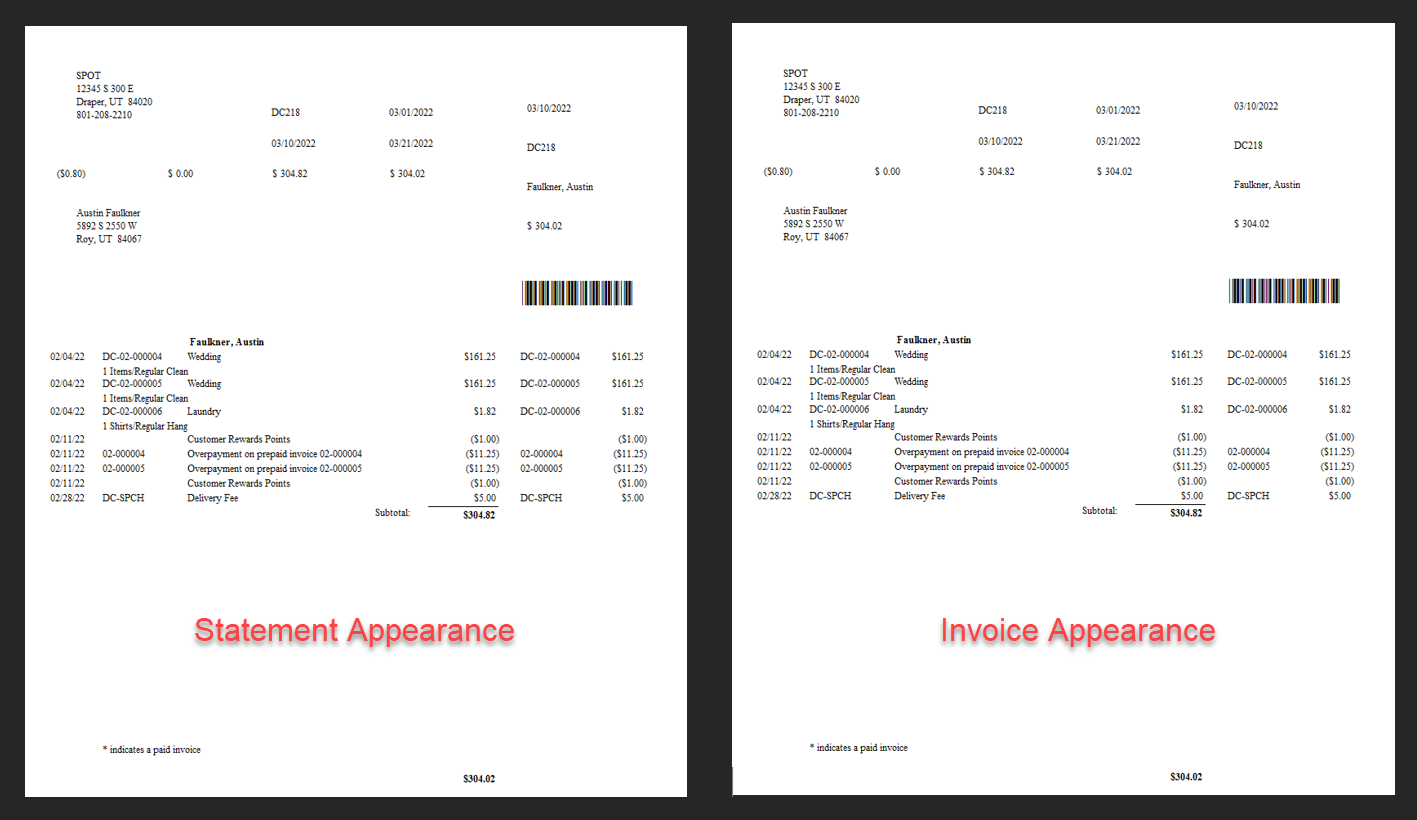
What it's for: pre-printed statement paper. If you want to purchase pre-printed statement paper, contact Sales at (801) 208-2212 or sales@spotpos.com.
Both appearances: identical. This template prints a barcode, so avoid it as the Custom Statement File (E-mail).
Statement1.rpt
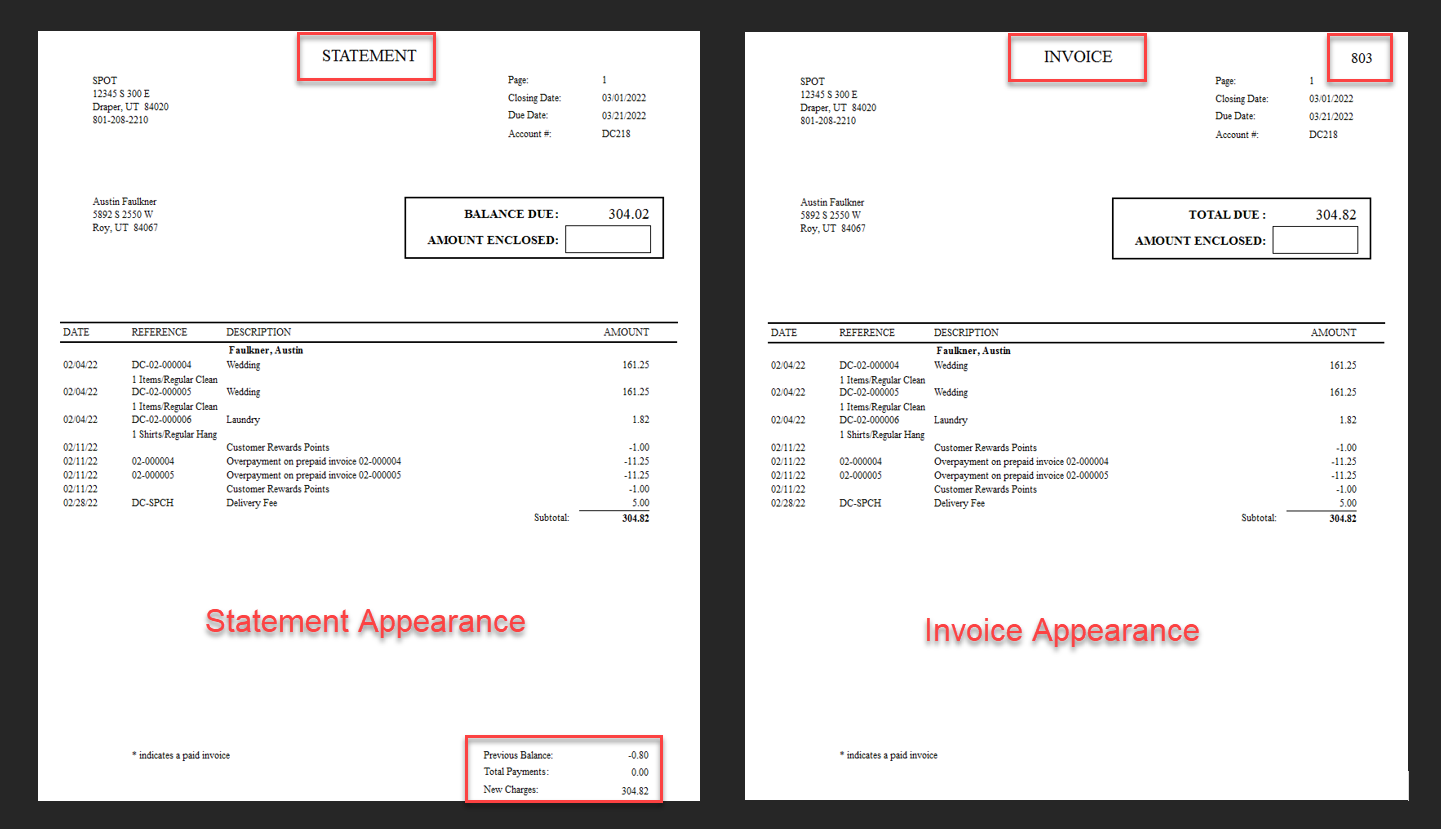
What it's for: the most common choice for check-payers. The top portion carries a Balance Due and an Amount Enclosed box for your customer to fill in and mail back.
Both appearances: store and customer addresses, closing date, due date, account number, and itemized activity with a subtotal.
Invoice Appearance changes:
The heading reads INVOICE instead of STATEMENT.
An invoice number prints at the top right.
The amount box reads Total Due and shows the period's charges, instead of Balance Due and the account balance.
The Previous Balance, Total Payments, and New Charges summary at the bottom right is not printed.
Statement1Perf.rpt
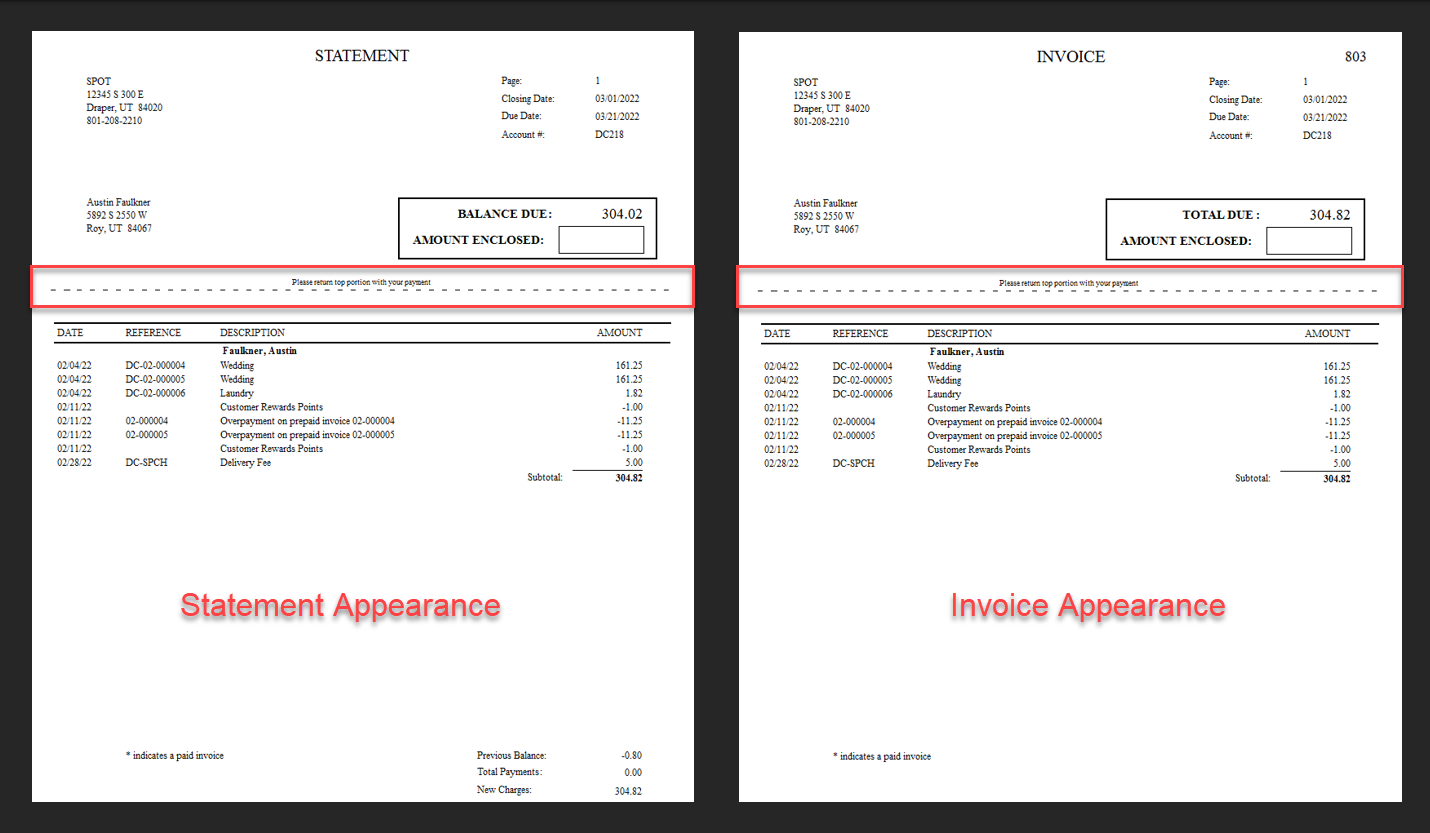
What it's for: the same as Statement1.rpt, with a perforated dotted line about a third of the way down and a "Please return top portion with your payment" note. This is the only template with a perforation line.
Both appearances: as Statement1.rpt.
Invoice Appearance changes: as Statement1.rpt. The heading reads INVOICE, an invoice number prints at the top right, the amount box reads Total Due for the period, and the bottom-right summary is not printed.
Statement2.rpt
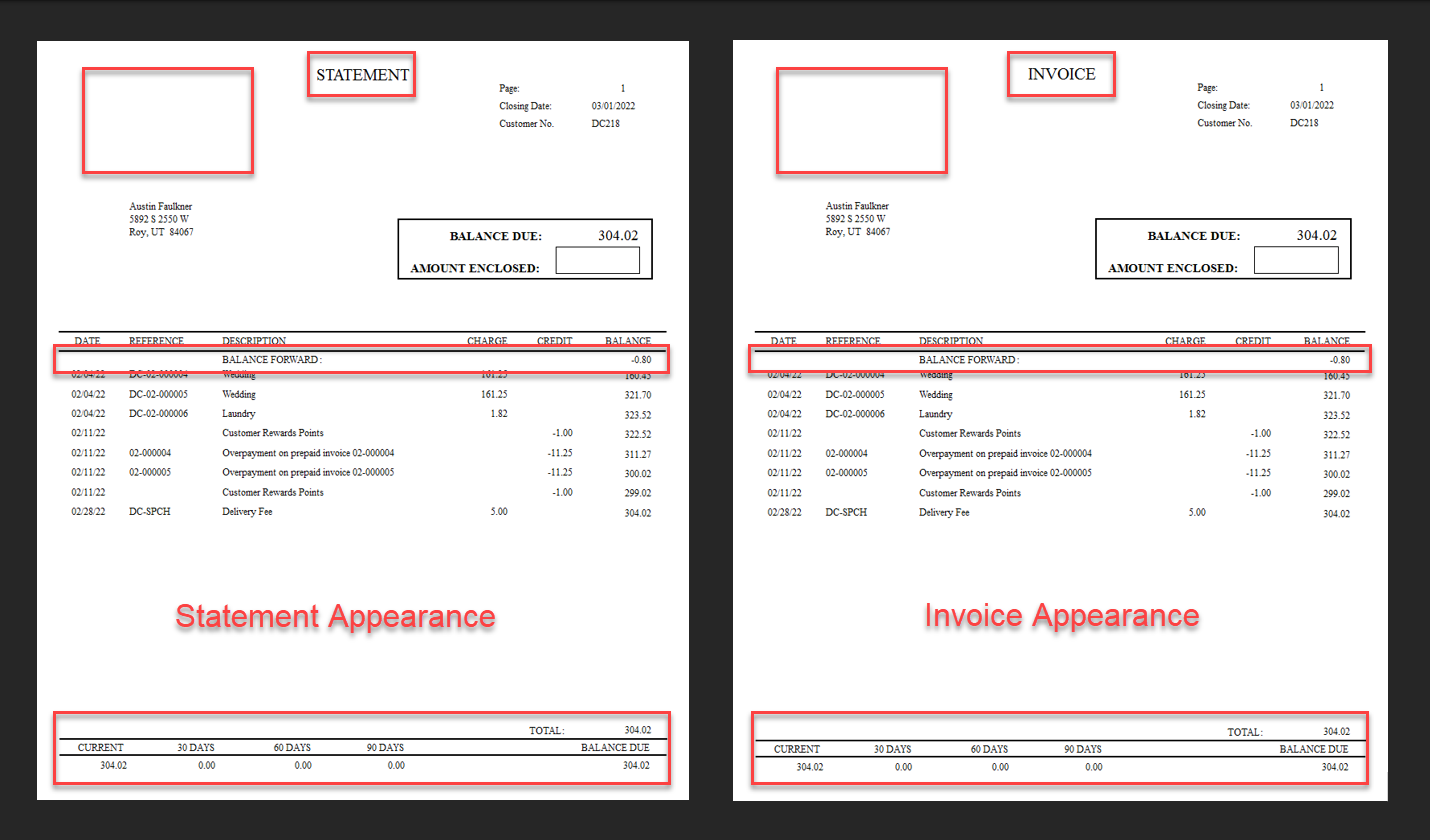
What it's for: an alternative to Statement1.rpt when you want the statement to show a running balance.
Both appearances:
A Balance Forward line shows all activity not paid or actioned since the last statement as one amount.
Each line carries Charge, Credit, and a running Balance.
No return address or billing entity is printed.
The balance summary sits at the very bottom as a Current, 30, 60, and 90 days aging row with the Balance Due.
Invoice Appearance changes: the heading reads INVOICE instead of STATEMENT. Nothing else changes. This template does not print an invoice number.
Statement3.rpt
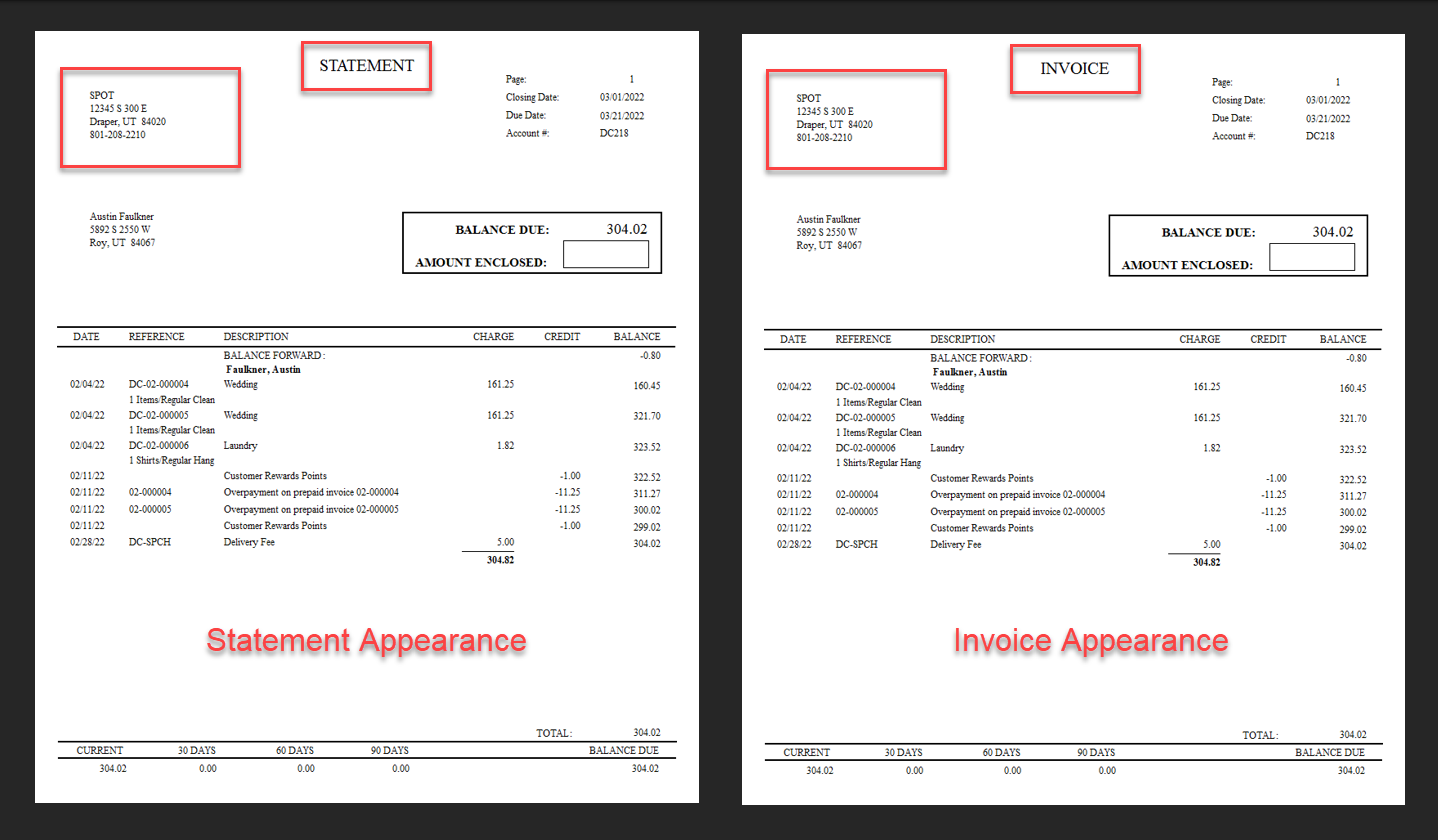
What it's for: the most commonly used statement template. It is Statement2.rpt with the return address and billing entity printed at the top left.
Both appearances: as Statement2.rpt, plus the store address block. Balance Forward is present for both appearances.
Invoice Appearance changes: the heading reads INVOICE instead of STATEMENT. Nothing else changes. This template does not print an invoice number.
Statement5.rpt
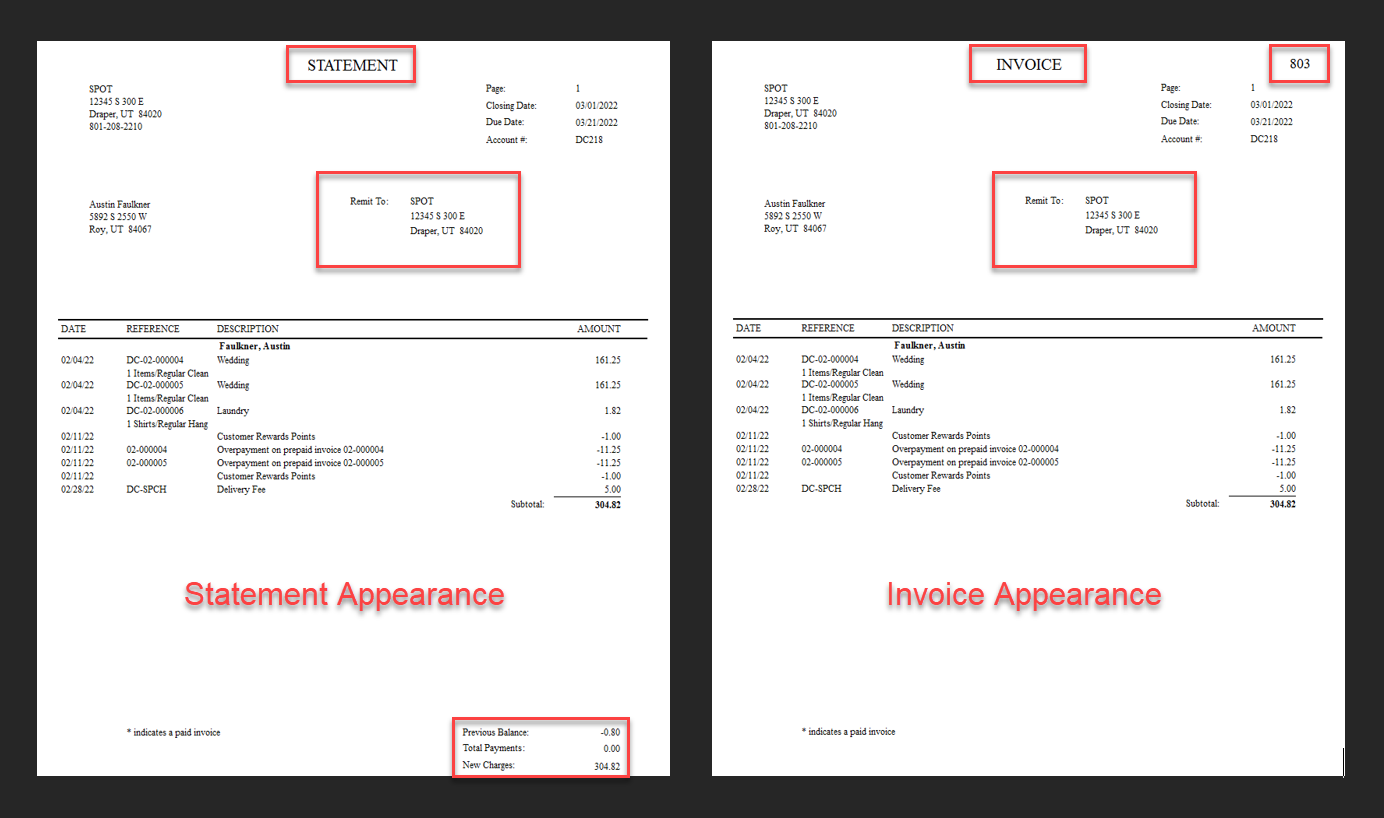
What it's for: the second most commonly used template, for your customers who remit to a billing address rather than tear off a payment stub.
Both appearances:
The Amount Enclosed section is replaced by a Remit To block with the billing entity and address.
No Balance Forward line and no aging row.
The summary is the simple Previous Balance, Total Payments, and New Charges breakdown used by Statement1.rpt and Statement1Perf.rpt.
Invoice Appearance changes:
The heading reads INVOICE instead of STATEMENT.
An invoice number prints at the top right.
The Previous Balance, Total Payments, and New Charges summary at the bottom right is not printed.
Which templates print a true invoice
Template | Invoice number on invoices | Amount box on invoices | Balance Forward and aging row | Perforation |
|---|---|---|---|---|
Statement.rpt | No (pre-printed paper) | Pre-printed | No | No |
Statement1.rpt | Yes | Total Due for the period | No | No |
Statement1Perf.rpt | Yes | Total Due for the period | No | Yes |
Statement2.rpt | No | Balance Due | Yes | No |
Statement3.rpt | No | Balance Due | Yes | No |
Statement5.rpt | Yes | Remit To block | No | No |